Friday, October 1, 2010
Friday, September 17, 2010
Reconstruction to Civil Rights
“There’s nothing more sickening to me than a low-grade white man who’ll take advantage of a Negro’s ignorance. Don’t fool yourselves – it’s all adding up and one of these days we are going to pay the bill for it.” – Atticus Finch
Like earthquake tremors, Atticus Finch in Harper Lee’s To Kill a Mockingbird (1960), forewarned of inescapable racial unrest that would peak during the Civil Rights Movement. The powerful sentiments of that Movement in the 1960s were reflections not only of that time period but of a damning and unjust social order, with a violent history of prejudice, initiated by the Reconstruction Era at the end of the Civil War. Since that early time African Americans have struggled to realize their potent potential as equal citizens in the United States of America.
Lynching, beatings and burnings were commonplace for African Americans in the period known as Reconstruction (1864 – 1877). With Whites vehemently opposed to the new social order imposed by the Republican Congress, and grieving over lost loved ones and destroyed property, violence and oppression ruled the Southern states. Federal courts gave African Americans equal civil rights and the right to vote by adding the 14th and 15th amendments to the Constitution. However, Southern states were left to form their own governments.
State governments, composed of the old White Supremacy groups, quickly endorsed Black Codes, which were a precursor to the Jim Crow laws. Blacks found themselves at the mercy of these codes, which restricted educational opportunities, sought minimal judicial justice for crimes committed against Blacks, and forced Freedmen to become share-croppers instead of land owners.
With cultural norms returning to a pre-Civil War atmosphere, Blacks were left to fend for themselves. Reuniting with family and organizing communities, African Americans made significant strides in education by using private and church schools. Businesses were opened and supported by Black customers and several forms of art, most notably music, were celebrated and enjoyed openly.

This advancement of African American fortunes was constantly plagued by organizations like the Ku Klux Klan. Founded in 1866 as a Tennessee social club, this group transformed its mission to become that of righteous, Christian defenders of the old social order. Most noted for the murdering of Blacks and White sympathizers, the burning of churches, schools and businesses, this group became a source of fear and terror to new communities.
Reconstruction efforts ended in 1877 with a general lack of interest from the Federal government. Northerners, at this time, began to feel it was entirely up to the Southern states to continue addressing integration issues. The Southern states responded by instituting Jim Crow laws in 1880. These laws segregated members of different races in all areas of life, affecting the education of Blacks the most significantly. These laws were upheld by the 1896 Supreme Court ruling in Plessy v. Ferguson that declared “separate but equal” cultural accommodations were constitutional.
Extreme, disparate segregation was the catalyst that finally created the human outrage that developed into the Civil Rights Movement of the late 1950s through the 1960s. This era has been called the “Second Reconstruction” because of its power and the organization of thousands of oppressed peoples.
Earning the right to fight combat missions, Black WWII soldiers returned home victoriously in 1954 only to find an unchanged and ungrateful nation. In the defeat of Nazism and the theory of “scientific racism”, where one race feels it is inherently superior to another, heroic Black soldiers were still called “boy”, asked to step aside and tip their hats to oncoming Whites and to sit in the back of the bus. Refusing to take cultural steps backwards, soldiers, along with newly expanded Black neighborhood populations and business centers joined to centralize the power needed to end racism. In 1954 segregation was ruled unconstitutional in a landmark decision by the Supreme Court in Brown v. Board of Education. Theoretically, Blacks would no longer be relegated to a sub-par education, living conditions or job opportunities.
With new momentum gaining to establish equal civil rights, organizations like the Ku Klux Klan resurfaced to once again terrorize communities. This time, however, leaders were caught and brought to justice for their crimes with assistance from the Federal government.

In full circle from the time of Reconstruction and the Freedman’s Bureau to numerous groups and organizations formed in the 1950s and 1960s, African Americans began to protest in earnest. Heroes such as Dr. Martin Luther King preached non-violent confrontation, preferring to use marches, rallies and strikes to send a message to the nation. Malcolm X led the Nation of Islam, who believed only a separate black state would achieve equality. Other militants organized under the name NAACP, the National Association for the Advancement of Colored People, and used litigation, legislation and education to advance equality. Racist treatment of African Americans, birthed at Reconstruction, was ultimately addressed during the Civil Rights Movement. The nation had finally started to “pay the bill” that was “adding up.”
Links:
HYPERLINK "http://www.pbs.org/wnet/jimcrow/jimcrowguide.pdf" www.pbs.org/wnet/jimcrow/jimcrowguide.pdf
HYPERLINK "http://www.digitalhistory.uh.edu/reconstruction/index.html" www.digitalhistory.uh.edu/reconstruction/index.html
HYPERLINK "http://www.academic.udayton.edu/race/02rights/jcrow02.htm" www.academic.udayton.edu/race/02rights/jcrow02.htm
HYPERLINK "http://www.shmoop.com/to-kill-a-mockingbird/race-quotes.html" www.shmoop.com/to-kill-a-mockingbird/race-quotes.html
HYPERLINK "http://www.lib.virginia.edu/exhibits/sixties/civil.html" www.lib.virginia.edu/exhibits/sixties/civil.html
HYPERLINK "http://www.bookrags.com/research/african-americans-world-war-ii-aaw-03/" www.bookrags.com/research/african-americans-world-war-ii-aaw-03/

Monday, September 13, 2010
Amnesty for the South?
During Reconstruction there was great debate over whether the South should be granted amnesty. What are your thoughts? Defend your argument.
Amnesty, in my opinion, was the only possible solution to reuniting the North and the South in the most efficient and expeditious way. Without fear of penalty, Confederates were allowed to rejoin the Union with their previous rights intact. Loyalty of the Southern population to the Union was of the utmost importance. With voting rights restored, these states were once again represented in the federal government and had a say in their destiny. Amnesty promotes the idea that there are no winners or losers in the battle; that preservation of the Union was the ultimate goal.
Amnesty defines the Civil War as an action to keep the Union whole, not as a punishment for slavery. The healing process could begin immediately without lingering bitterness or penalties.
Amnesty, in my opinion, was the only possible solution to reuniting the North and the South in the most efficient and expeditious way. Without fear of penalty, Confederates were allowed to rejoin the Union with their previous rights intact. Loyalty of the Southern population to the Union was of the utmost importance. With voting rights restored, these states were once again represented in the federal government and had a say in their destiny. Amnesty promotes the idea that there are no winners or losers in the battle; that preservation of the Union was the ultimate goal.
Amnesty defines the Civil War as an action to keep the Union whole, not as a punishment for slavery. The healing process could begin immediately without lingering bitterness or penalties.
40 Acres and a Mule
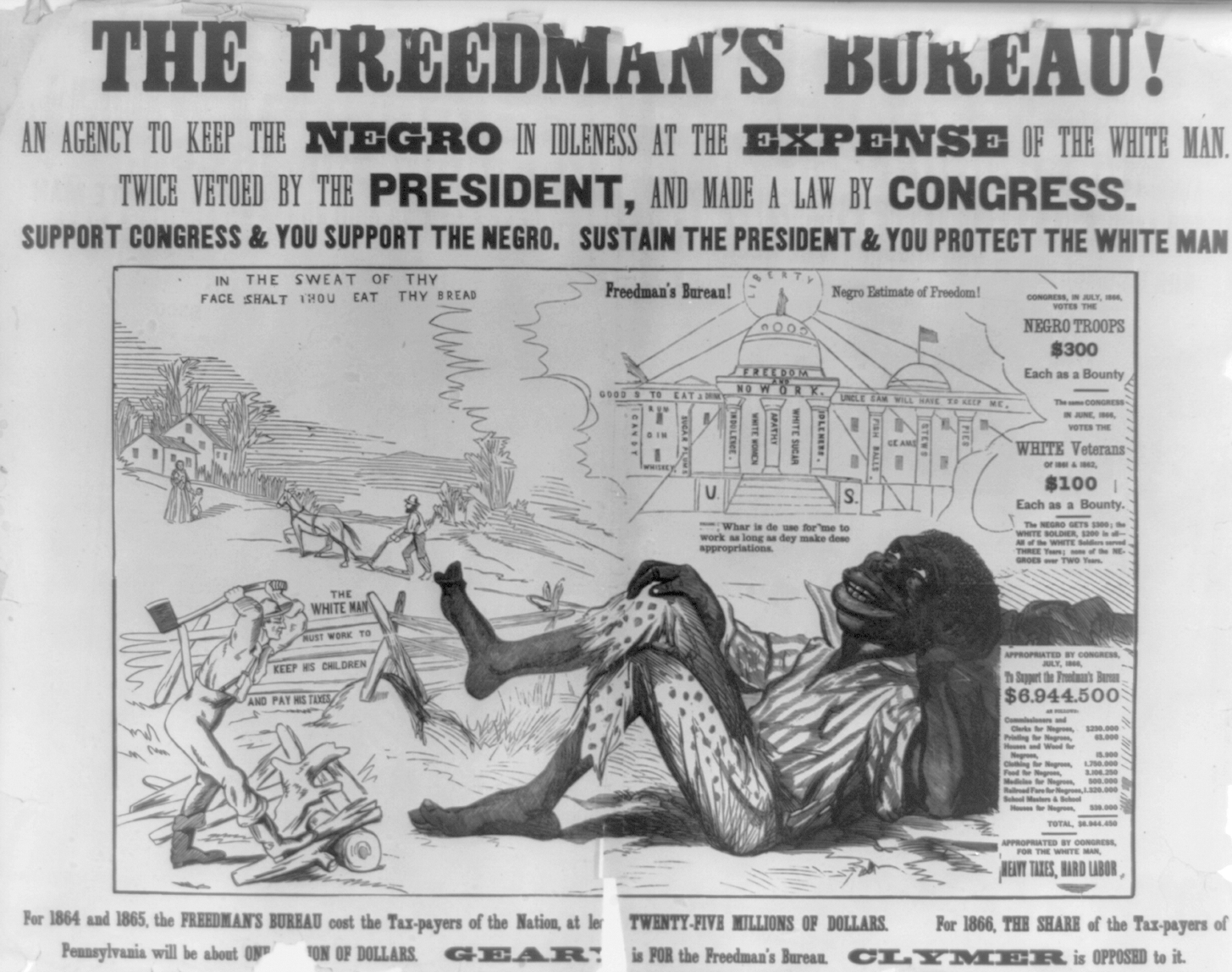
This poster represents the fear that white farmers were losing control over the previous traditions and hierarchy of the society. The depiction of the black man as lazy and uneducated without supervision supports a classic stereotype. Meanwhile, the white farmers appear productive, hardworking, and educated. How could congress create a beaurocracy so inept and unfair?
Image Source: (http://upload.wikimedia.org/wikipedia/commons/3/33/Freedman%27s_bureau.jpg)
Wednesday, September 8, 2010
That's So Stereotypical
Why do you think that stereotypes are so widely known by so many in our society?
"You're such a blonde..." "You're a redhead so you must have a temper..." "Only white people go there..."
Stereotypes. There is a stereotype for every type of person, whether you are black, white, blonde, female, etc. The majority of the population knows of these groupings, and most people either agree with them or don't know any better. It's what the population has grown up with. Our thoughts are influenced by our parents, relatives, friends, teachers, history, and the media.
Some stereotypes can be explicit, others can be disturbing, and some can be downright racist. There are many stereotypes associated with race and ethnicity in the United States. Some are taught to us before we know the real meaning behind them, when we are too young to understand. The history of different ethnicities and the different events that have taken place in America regarding these ethnic groups have influenced how they are categorized today. For example, some ethnicities are looked down upon because of the time period of the Civil War and slavery.
The media and television also present well-known stereotypes to us daily. Shows on TV often emphasize stereotypes to be humorous and to relate to the audience, with countless amounts of jokes.
Stereotypes are presented to us no matter what we do, no matter where we turn, so they are widely known in our society today.
"You're such a blonde..." "You're a redhead so you must have a temper..." "Only white people go there..."
Stereotypes. There is a stereotype for every type of person, whether you are black, white, blonde, female, etc. The majority of the population knows of these groupings, and most people either agree with them or don't know any better. It's what the population has grown up with. Our thoughts are influenced by our parents, relatives, friends, teachers, history, and the media.
Some stereotypes can be explicit, others can be disturbing, and some can be downright racist. There are many stereotypes associated with race and ethnicity in the United States. Some are taught to us before we know the real meaning behind them, when we are too young to understand. The history of different ethnicities and the different events that have taken place in America regarding these ethnic groups have influenced how they are categorized today. For example, some ethnicities are looked down upon because of the time period of the Civil War and slavery.
The media and television also present well-known stereotypes to us daily. Shows on TV often emphasize stereotypes to be humorous and to relate to the audience, with countless amounts of jokes.
Stereotypes are presented to us no matter what we do, no matter where we turn, so they are widely known in our society today.
Is Less Really More?
When Thoreau said, "that government is best which governs least", what do you think he meant? Do you agree or disagree? Explain.
Government provides control and order in a society. Without it, there would be chaos, but Thoreau saying that a government that controls the least amount of things for its people is best seems somewhat reasonable to me.
The government should have control over its people, but it should only interfere if it is absolutely necessary. Often times when people are governed and controlled excessively, they rebel and create an uprising against unjust government officials; but when a government creates guidelines for safety and the welfare of a society, and does not restrict too many rights, it works best.
Governing important issues while ensuring freedoms, rights, and happiness in a society is the ideal combination. An overwhelming amount of government control leads to unhappiness and corruption of power. Thoreau's statement exemplifies that the lesser amount of government control there is, the better.
Government provides control and order in a society. Without it, there would be chaos, but Thoreau saying that a government that controls the least amount of things for its people is best seems somewhat reasonable to me.
The government should have control over its people, but it should only interfere if it is absolutely necessary. Often times when people are governed and controlled excessively, they rebel and create an uprising against unjust government officials; but when a government creates guidelines for safety and the welfare of a society, and does not restrict too many rights, it works best.
Governing important issues while ensuring freedoms, rights, and happiness in a society is the ideal combination. An overwhelming amount of government control leads to unhappiness and corruption of power. Thoreau's statement exemplifies that the lesser amount of government control there is, the better.
Thursday, September 2, 2010
It's All a Lie
"History is the lie commonly agreed upon." What did Voltaire mean by this quote?
If everyone in the entire world who ever lived wrote down everything that happened to them and everything they observed and heard every second of every day, we might have an accurate history of the world in textbooks today. Unfortunately, that is not even remotely close to the case.
The history we know today is based off the viewpoints of the people who wrote it, and that means there is bias, and that only certain perspectives are expressed. In the United States for instance, as I mentioned in an earlier blog post, our history books have neglected to mention any stories of surrender. In America, it seems as if we have "agreed" to ignore those stories. Because we have ignored them for so long, they are not a part of the history that we learn today.
We are taught in schools that Paul Revere yelled "The British are coming!" all the way to Lexington to warn the people. We know this because of the common poem which states this information. The truth of the matter is that Paul Revere began this journey, but was captured and failed his mission. Paul Revere's name rhymed in the poem however, so this is what we are taught.
Common misconceptions are rampant in history books, and Voltaire's quote expresses this fact.
If everyone in the entire world who ever lived wrote down everything that happened to them and everything they observed and heard every second of every day, we might have an accurate history of the world in textbooks today. Unfortunately, that is not even remotely close to the case.
The history we know today is based off the viewpoints of the people who wrote it, and that means there is bias, and that only certain perspectives are expressed. In the United States for instance, as I mentioned in an earlier blog post, our history books have neglected to mention any stories of surrender. In America, it seems as if we have "agreed" to ignore those stories. Because we have ignored them for so long, they are not a part of the history that we learn today.
We are taught in schools that Paul Revere yelled "The British are coming!" all the way to Lexington to warn the people. We know this because of the common poem which states this information. The truth of the matter is that Paul Revere began this journey, but was captured and failed his mission. Paul Revere's name rhymed in the poem however, so this is what we are taught.
Common misconceptions are rampant in history books, and Voltaire's quote expresses this fact.
Subscribe to:
Posts (Atom)